Local decision models · Marine autonomy · Closed-loop evaluation
JevNav.
A model chooses a maneuver. The whole system makes it work.
A navigation experiment using the local Laya model. Geometry checks the candidates, conventional control executes the choice, and recorded trials reveal how the vessel moves through obstacles and traffic.
01 / Laya selects. The WAM-V passes the post.Gazebo pose replay · recorded October 9 · rendered October 22
01 / A constrained decision problem
Where can a model help a boat navigate?
JevNav asks a pretrained decision model to choose among feasible navigation references. The engineering challenge is connecting that choice to a moving vessel with inertia, steering limits, stale observations, and a route to finish.
The test platform is a WAM-V uncrewed surface vessel in VRX and Gazebo. A local, pinned English Laya checkpoint receives a compact description of state and candidate maneuvers. It returns a candidate ID. Heading PD control—and speed PI in the joint-control extension—computes the actuator commands.
The study grows from static obstacles to paired heading/speed decisions, moving traffic, and navigation from GPS, IMU, and lidar measurements. A companion Marine Testbed makes the timing, command application, and failure handling inspectable.
Project scope
Navigation, model integration & evaluation
Core tools
Python · ROS 2 Jazzy · Gazebo Harmonic · Docker
Model
Local Laya · pinned English checkpoint · no marine fine-tuning
Evidence
Recorded simulation · reviewed October 25, 2026
02 / Two views of a decision
See the motion. Inspect the choice.
A static post and an oncoming vessel expose different parts of the same loop: predict feasible motion, select a reference, then steer the boat.
The Gazebo views pose the WAM-V from recorded simulator truth. Physics and the controller are disabled during rendering; water and sky are added for presentation. The planner views draw saved states, candidate paths, and decisions, then hold the final frame for 2.5 seconds. They associate choices with their source observations, rather than replaying response-arrival timing.
A / Static obstacle · Laya
Choose a path past the post.
The October 9 collection run completes the route in 34.0 simulated seconds, with 1.78 m minimum hull clearance. Laya selects 68 times; 36 choices match the conventional selector. The heading controller executes the selected references.
Static post · seed 73 · fixed timingGazebo pose replay · silent · 1× simulation time
The WAM-V turns around the post and returns toward the route. The recorded hull clearance includes the boat’s footprint. The water in this rendering does not represent an additional wave-disturbance experiment.
Inspect the static mission’s candidate paths
Rejected, feasible, shortlisted, and chosen trajectories appear with Laya’s output probabilities and the conventional pick. Probabilities are model outputs, not calibrated measures of navigation safety.
Recorded state + candidate diagnosticsSilent · 1× simulation time
B / Head-on encounter · Laya
Choose heading and speed together.
The encounter is classified as head-on with a give-way role. Laya selects from heading-and-speed candidates; the WAM-V alters to starboard and passes with 3.53 m minimum hull-to-hull clearance. This case meets every declared check. Of 138 model decisions, 131 match the conventional pick.
The blue box is the simulator’s hull proxy for the scripted target vessel. The WAM-V turns to starboard for a port-to-port pass. This original experiment used ideal target reports.
Inspect the head-on choices and encounter state
The diagnostic replay joins vessel motion to the selected maneuver, encounter role, range, and closest-approach estimates. Decisions are displayed at their source candidate timestamps, so this retrospective view does not reproduce response-arrival timing.
Recorded state + candidate diagnosticsSilent · 2× simulation time
These are selected successful examples from October 8–9. The full comparison below includes unsuccessful missions. A third example uses measured lidar tracks with conventional selection.
03 / The navigation loop
Generate. Check. Choose. Recheck.
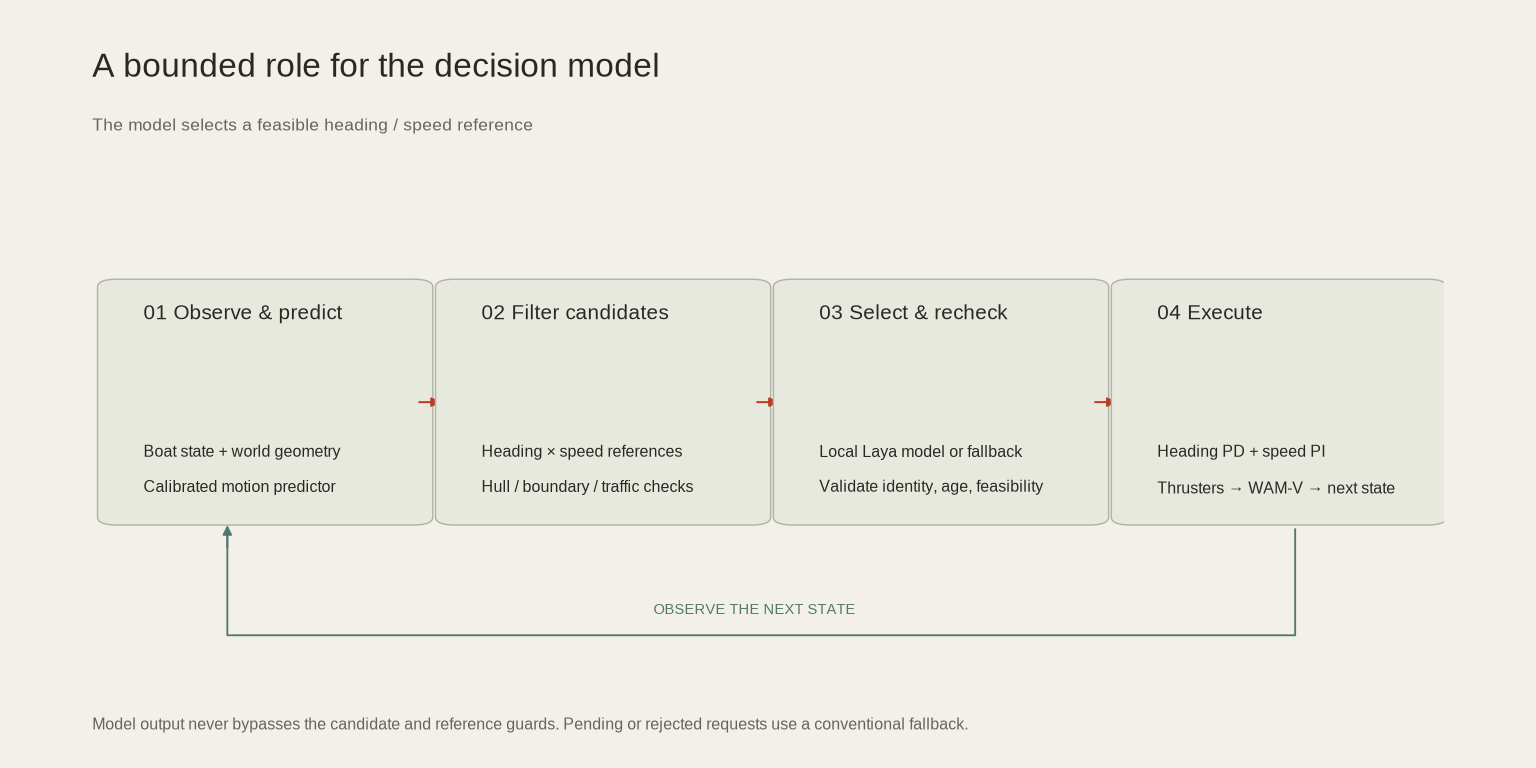
Line-of-sight guidance supplies a route heading. A calibrated motion predictor rolls out candidate references through the controller. Hull geometry, buffered obstacles, boundaries, and traffic constraints reduce them to a shared shortlist.
The same feasibility checks serve the model, conventional, and random selectors. An empty feasible set produces a recorded navigation failure and neutral actuation.
A response is useful only while its original context is valid. Each request carries the episode, mission, candidate-set identity, source observation, and deadlines. Accepted choices are simulated again from the latest state before becoming an expiring reference.
Inside the model and controller boundary
A bounded choice
The pinned model has a 512-token input limit. The shortlist contains at most eight candidates, with separate question and option budgets. Compact fields describe progress, route error, clearance, heading change, and control effort.
A checked response
The client verifies the selected ID, finite normalized probabilities, input audit, model identity, and timing. A valid HTTP response alone is insufficient to create a reference.
Conventional feedback
The 20 Hz heading controller remains independent of model HTTP inference. Joint control adds bounded speed PI with rate limits and anti-windup. Zero target speed requests coasting.
Changing traffic
Candidate trajectories are checked against time-aligned target predictions and declared encounter constraints. Latest-state checks account for motion while a decision is pending.
04 / Engineering decisions
Make every choice accountable.
01 / Define the action space
Predict the executed maneuver.
Rollouts include the controller, steering slew, command delay, and coasting behavior. The geometric check therefore evaluates the maneuver the system would execute, including the vessel’s footprint.
02 / Preserve freshness
An old answer stays old.
Late results retain their original timestamps and identity. They can be rejected as expired, superseded, or tied to a replaced mission. Receiving a response never renews its source observation.
03 / Keep control available
Fallback is part of the loop.
While inference is pending or invalid, a conventional reference passes through the same current-state checks. Fault tests exercise timeouts, outages, malformed answers, and delayed replies.
04 / Compare the actual choice
Share the shortlist.
Model, conventional, and seeded random selection use the same candidate machinery. Separate ablations expose the effects of removing encounter-rule filtering or using LOS-only control.
05 / The comparison
Integration works. Advantage remains unproven.
In the moving-traffic comparison, conventional selection passed 15 of 20 trial checks; the model passed 14. The model’s successful integration did not translate into a demonstrated navigation advantage.
Frozen traffic matrix100
10 scenes × 5 variants × 2 timing modes
Conventional trials passing all checks15/20
Includes two expected neutral-fallback cases
Model trials passing all checks14/20
Same scenes, candidate pipeline, and evaluation criteria
These trials use seed 131, calm water, one scripted non-reactive target per scene, and ideal target reports. Fixed and continuous modes are both included.
Keep route completion, full checks, and contacts separate.
Selector
Trials passing all checks
Moving routes completed
Trials with target contact
Conventional
15 / 20
18 / 18
0 / 20
Local model
14 / 20
15 / 18
0 / 20
Random feasible
14 / 20
13 / 18
0 / 20
Conventional, rules unenforced
6 / 20
18 / 18
0 / 20
LOS only*
6 / 20
6 / 18
14 / 20
Each 20-trial group contains 18 moving missions and two anchored-vessel neutral tests. A completed route may still violate other criteria. *LOS removes joint-control and encounter criteria. These small, single-seed comparisons are descriptive.
What the failures explain
The unruled planner completed every moving route while passing only six trial checks. Collision avoidance and route completion leave other requirements unresolved. Model failures include rule departures, excessive cross-track error, empty feasible sets, and recheck deadlines.
Compare model and conventional selection in one crossing
A separate continuous-mode crossing pair, seed 131, makes the tradeoff visible: both runs pass, but the model waits longer and finishes with greater clearance. The target follows the same script; live timing differs between runs.
One scene, two successful runs. The model’s larger passing clearance comes with a longer completion time. Clearance is the recorded swept hull-to-hull bound, not centre distance.
The paired animation plays at 4× simulated time, holds each vessel at its final recorded pose, and omits terminal-neutral coasting.
Earlier experiments and environment checks
Static and stress scenes
The 32-trial M4 matrix used two scenes, two seeds, four selectors, and two timing modes. Conventional, model, and random selection each passed 4/8 trials. All passed the static scene; none passed every criterion in the combined-noise, lateral-force stress scene.
Heading and speed together
In the separate joint-control suite, conventional selection passed all four moving missions; the model passed one of four. Blocked-route fallback checks are excluded from those denominators. Three model timeouts remain in the record.
October 9 model-driven run
On October 9, the frozen static scene was rerun in Docker with seed 73. It completed in 34.0 simulated seconds with 1.78 m minimum obstacle clearance, zero contact reports, and 682 acknowledged commands, including terminal neutral.
Scope of verification
The October 25 Docker check passed 547 tests with one opt-in contact fixture skipped. The host check ran 548 tests with 15 skipped: 533 executed tests passed. Test counts describe their environment; navigation performance comes from the recorded trials.
06 / Closing the sensing gap
Good tracks still need good decisions.
GPS/IMU filtering and lidar perception replace truth inputs in the sensor extension. Static-post tracks feed obstacle checking; rectangular-vessel fitting and constant-velocity Kalman tracks provide moving-target estimates. Measurement age and uncertainty widen the planning margins.
The measured-traffic study used conventional selection. Across its recorded in-range samples, the largest target position error was 0.220 m and velocity error 0.062 m/s. Yet only four of 18 moving missions passed every criterion. Two expected neutral tests bring the complete trial-check count to 6/20.
C / Crossing traffic · Conventional selection
Navigate on the lidar track.
In this successful measured-traffic case, the crossing vessel reaches the planner through lidar. The WAM-V slows and coasts while it passes, then completes the route with 7.55 m minimum hull-to-hull clearance. A confirmed track is present in every evaluated in-range control sample; the 95th-percentile track position error is 0.095 m.
Crossing · seed 151 · fixed timing · full sensor modeGazebo pose replay · silent · 3× simulation time
The blue target crosses ahead while the WAM-V reduces propulsion and gives way. Zero target speed requests coasting; this behavior does not establish station keeping.
Inspect lidar returns, the estimated track, and truth
Raw lidar returns and the estimated target track appear alongside simulator truth for evaluation. The dashed track and uncertainty show the perception output; truth provides the position-error reference.
Better perception alone did not solve mission completion. Conservative observed-space checks, rule margins, limited prediction horizons, and changing feasible sets could leave no acceptable maneuver. The retained traces make those interactions available for the next iteration.
The evidence covers calm-water simulation and declared target geometry. Measured-track tests use conventional selection; they do not validate the model on lidar inputs. Encounter constraints implement a limited quantitative interpretation of selected maritime rules. Field performance and regulatory compliance are outside this study.
07 / Traceable evidence
Keep the result inspectable.
The October 22 renderings make three existing runs inspectable. The October 25 review checks their compact records against the source evidence. The navigation, control, perception, and native actuation code are unchanged from the earlier collection; the update adds presentation tools and suite preflight checks.
The pretrained decision model is Laya. The WAM-V platform and maritime simulation come from VRX and Gazebo, with ROS 2 integration. JevNav supplies the navigation pipeline, selection adapter, experiment orchestration, and its native actuation extension. The model weights and upstream simulator are external components.
Inspected source revision: 3c9a6fc · October 25, 2026. Renderings were produced October 22 from 2ad2780; archived trials retain their original manifests. No physical-vessel trial is represented by these materials.